
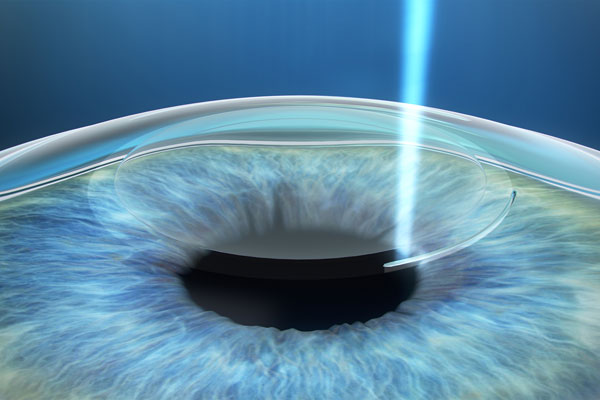
What is Femto-LASIK?
LASIK, widely regarded as one of the most common, precise, and safe refractive surgery procedures, is a two-step corneal operation. Femto-LASIK is one of the most modern methods for correcting myopia (nearsightedness), hyperopia (farsightedness), and astigmatism. All procedures are performed using an excimer laser and offer an exceptionally safe profile.
How is Femto-LASIK Performed?
In terms of surgical stages, Femto-LASIK is very similar to standard LASIK. The core distinction is that standard LASIK creates the corneal flap mechanically using a microkeratome blade, whereas Femto-LASIK creates this flap entirely with a laser, allowing for optimal thickness control and outstanding precision. Currently, Femto-LASIK is among the most popular refractive correction methods across Europe and the United States.
Stages of Femto-LASIK
The eye is fully numbed using anesthetic eye drops.
Under computer guidance, the femtosecond laser is focused to a predetermined corneal depth, creating an ultra-thin flap on the corneal surface (approximately 90 to 110 microns).
Depending on the type and magnitude of the refractive error, the cornea is reshaped using the excimer laser.
The flap is repositioned to its original place to serve as a natural biological dressing that protects the treated tissue. This layer adheres rapidly on its own without requiring sutures.
Advantages of Femto-LASIK Surgery
Fewer Complications
Rapid Recovery: Most patients resume daily routines within one to two days. Procedure is virtually painless, and functional vision is achieved within 24 hours (unlike RK or PRK, which involve greater discomfort).
Preservation of Natural Corneal Architecture: The thin flap becomes securely fixed within a few days and will not shift with normal blinking or light rubbing. Unlike RK (radial keratotomy), corneal biomechanical strength and impact resistance are preserved.
Long-Term Stability: Clinical studies demonstrate that refractive outcomes stabilize within 3 to 6 months due to minimal ongoing structural alterations.
Reduced Risk of Infection and Swelling
Reduced Flap Complications: Significantly lowers the risk of buttonholes, free caps, or irregular cuts.
Thinner Corneal Flaps: Enables the creation of thinner flaps to correct higher refractive errors in patients with thinner corneas.
Enhanced Predictability of Corneal Thickness: Because the surgeon determines the exact dimensions, depth, and positioning of the flap prior to cutting, patients with higher prescriptions achieve superior outcomes with enhanced flap repositioning accuracy.
Medical Instructions for Femto-LASIK Surgery
Before Femto-LASIK Surgery:
The doctor conducts all necessary diagnostic scans and measurements prior to surgery.
Local anesthesia is administered via topical eye drops.
During LASIK / Femto-LASIK Surgery:
These procedures are painless, and your cooperation is essential for the best surgical outcome. Remain calm and follow all instructions closely.
Fixate steadily on the blinking red or green target light throughout the procedure, avoiding head and eye movement.
Laser delivery typically lasts less than a minute (usually around 10 seconds). Keep your gaze fixed while the laser sound is active.
Do not worry about blinking; a gentle eyelid speculum keeps the eye open. Avoid squeezing your eyelids or frowning to maintain full comfort.
Keep your hands away from the sterile surgical field to prevent contamination.
After LASIK / Femto-LASIK Surgery:
Rest in the recovery area for approximately 30 minutes following the procedure.
Driving and public transit are prohibited on surgery day; an accompanying person is required.
Post-operative medication consists of prescribed eye drops.
Wearing UV-protective sunglasses is mandatory for the first 24 hours.
Follow-up checkups are scheduled on Day 1, Week 1, and Month 1.