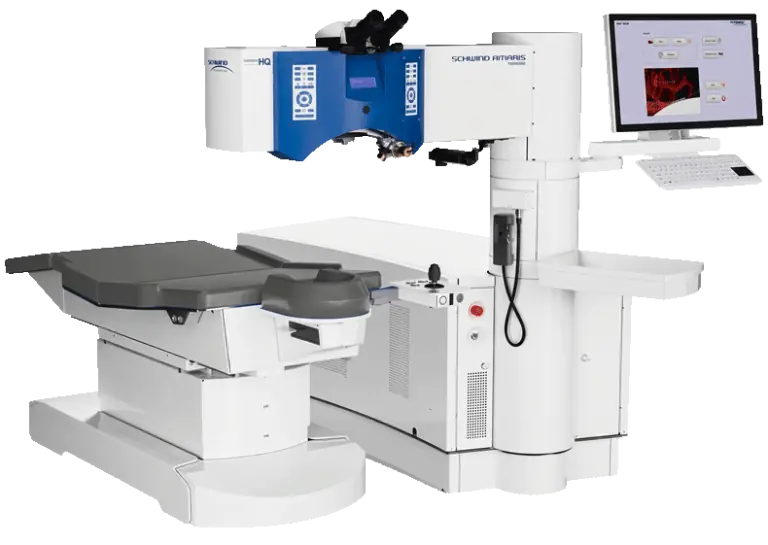
Trans-PRK Surgery
In conventional PRK, the superficial layer of the cornea (epithelium) is removed mechanically using manual surgical instruments or alcohol solutions. In Trans-PRK (Transepithelial Photorefractive Keratectomy)—also known as the “No-Touch” technique—the epithelium is removed directly by the excimer laser rather than manually, eliminating mechanical scraping and intraoperative discomfort.
Next, the excimer laser sculpts the corneal stroma in a single, continuous step to precisely adjust its curvature and correct the refractive error. Finally, a therapeutic bandage contact lens is placed over the eye. New epithelial cells regenerate completely within approximately 5 days, after which the bandage lens is safely removed by the ophthalmologist.
Trans-PRK is an advanced, all-laser procedure. Because no surgical instruments physically touch the eye surface (100% No-Touch, All-Laser), the procedure is entirely painless during execution. Candidacy for Trans-PRK depends on your individual corneal parameters and is determined following a comprehensive evaluation by the ophthalmologist. During the procedure, remain still, avoid head and eye movements, and follow the surgeon’s guidance closely.

Key Technical Features & Advantages (SCHWIND AMARIS 1050RS Laser Platform):
- World’s Fastest Excimer Laser: 1050 Hz pulse rate for ultra-fast ablation.
- Comprehensive Refractive Correction: Precise treatment of myopia, hyperopia, and astigmatism.
- Touch-Free & Painless (No-Touch Technique): True all-laser, single-step surface ablation.
- Top-Tier Vision Correction Technology in Mashhad
- Ultra-Short Surgical Duration: Minimizes corneal exposure and dehydration time.
- 7D Active Eye-Tracking: Unmatched sub-millimeter precision compensating for all ocular micro-movements.
- Intelligent Thermal Effect Control (ITEC): Prevents corneal overheating and preserves adjacent tissue integrity.
- Real-Time Online Pachymetry: Continuous corneal thickness monitoring during ablation for maximal surgical safety.
- Versatile Treatment Spectrum: Highly effective for complex cases, including thin or irregular corneas.
- Refractive Enhancement & Retreatment: Precision correction for previous surgical regressions or residual errors.
- Automated Data Integration: Seamless transfer of diagnostic wavefront and corneal topography profiles directly to the laser platform.